Summary / Key takeaways
Healthcare waste management is an essential component of safe, sustainable, and high-quality care. Healthcare facilities generate large volumes of waste every day, including general waste, biomedical waste, pharmaceutical waste, hazardous materials, and sharps. While only a small proportion of healthcare waste requires specialized treatment, improper segregation often results in unnecessary incineration or sterilization, increasing costs, greenhouse gas emissions, and environmental pollution. Evidence suggests that up to 85% of healthcare waste can be safely managed through general waste, recycling, or composting streams when correctly segregated. Improving waste management therefore represents a major opportunity to reduce environmental impacts while maintaining patient and staff safety.
Sustainable waste management requires clear understanding of waste categories, regulations, and treatment methods such as autoclaving, hydroclaving, microwaving, and incineration. Practical tools support change by helping organizations strengthen waste segregation practices, conduct waste audits, update internal policies, and reduce overall waste generation through approaches such as reuse, reprocessing, recycling, and the “10 Rs” framework.
Successful implementation depends on staff education, leadership support, collaboration with waste vendors and local partners, and embedding sustainable waste practices into everyday clinical and operational workflows. Exploring practical resources, case studies, and implementation tools can help healthcare teams identify realistic opportunities to improve waste management, reduce environmental harm, and support safer, more sustainable systems of care.
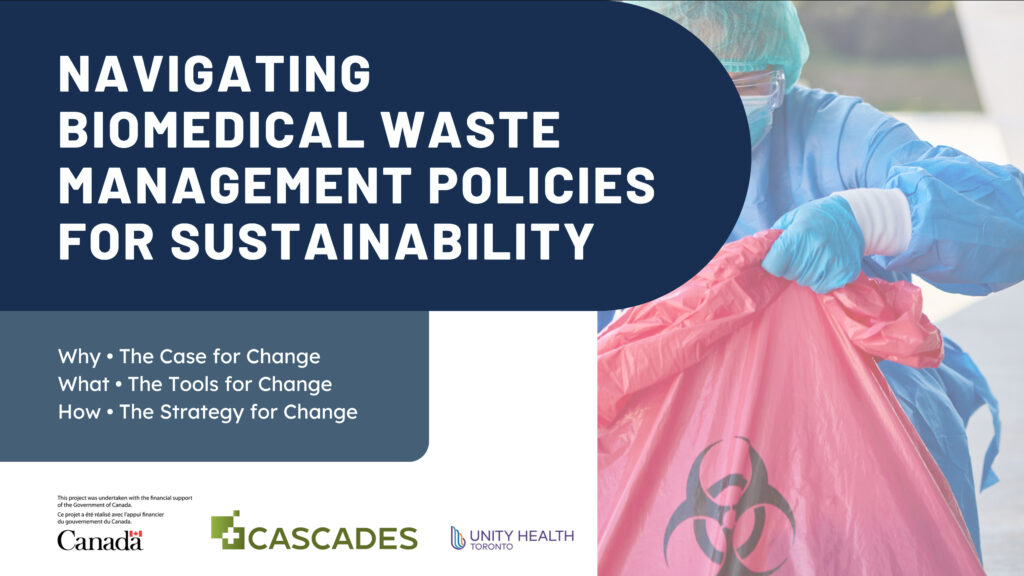
Playbook: Navigating biomedical waste management policies for sustainability
Suggested Citation:
Machane S, MacLeod C, Lam I. Navigating Biomedical waste management policies for sustainability. Version 1.1. [Internet]. CASCADES; 2024 [cited DATE]. Available from: https://www.cascadescanada.ca/.